Constable Martin Clarke, 64977, died on the main Lanesboro–Roscommon road at Moneen, Co. Roscommon, three miles from Lanesboro. At about 5.30pm on Wednesday the 14th July 1920, he and another member of the Royal Irish Constabulary, Constable Laurence Joseph Macken, 67165, were on duty, cycling to Roscommon, when they were ambushed at Moneen by armed men, who fired on them, killing Constable Clarke. This ambush was carried out by the Kilgefin Company, 3rd Battalion of the South Roscommon Brigade of the I.R.A. The details of the ambush were subsequently published in newspapers both locally and nationally at the time.
“On the night of the 10th July 1920 a dispatch was received from Cloontuskert Coy, with information to the effect that some of the R.I.C. stationed at Lanesboro were to travel to Roscommon on the following day to attend at the assizes. Acting on the information it was decided to ambush them at Moneen on the road leading from Lanesboro to Roscommon.”
“Two R.I.C. men arrived soon afterwards and were called on to ‘Halt’, but they increased their speed. The Fire Order was then given by the O/C (P. Madden) and one R.I.C. man was killed after he had cycled about two hundred yards from where ‘Halt’ was given; the other R.I.C. man continued at great speed to cycle towards Roscommon, but was pursued by our men and captured.”
“Two carbines, two revolvers, and about 200 rounds of .303 ammunition and 100 rounds of .45 ammunition was captured.”
The following persons took part in the ambush: Pat Madden, Ballagh, Kilrooskey; Frank Simons, Abbey Street, Roscommon; Gerald Davis, Fossagh Ho., Finglas Road, Glasnevin, Dublin; Henry Compton, Tuam, Kilrooskey, Roscommon; Patrick Tiernan, Sheeane, Kilrooskey, Roscommon; John Scally, Portnahinch, Lanesboro, Longford; John O'Connor, Lisnaria, Lanesboro, Longford; Peter Egan, Portnahinch, Lanesboro, Longford; Luke Duffy, Clooncagh, Leckin, Strokestown, Longford; and Frank Madden, Ballagh, Kilrooskey, Roscommon.
Bureau of Military History — statements
Michael Ryan, Lanesboro, Co. Longford, was a Commandant in the 3rd Battalion, Longford Brigade between 1918–1921. He was interviewed on the 20th December 1951 by the Bureau of Military History relative to the ambush at Moneen. In his account he details how a Constable Kearney, whom he was friendly with and who was stationed in Lanesboro, told him that Constable Clarke and another constable were going to Roscommon as members of a guard of honour to meet the judge who was to sit at Roscommon Assizes. Ryan subsequently got in touch with Pat Madden, Kilrooskey, Co. Roscommon, who was the O/C of the only active battalion in Roscommon, and gave him this information.
Michael Ryan was not present or involved in the ambush directly; however he gave the following details:
“There was a big ‘splash’ in the newspapers about this and the British made out that Constable Clarke had been knifed as well as being shot. What actually happened was that the barrel of the weapon that fired the shot that killed Clarke was badly scored. This gave the bullet a jagged surface which caused a jagged wound.”
Luke Duffy, Clooncagh, Strokestown, Co. Roscommon, was the O/C of E Coy (Kilgeffin), 3rd Battalion, South Roscommon Brigade in 1920. On the 26th March 1952 Luke Duffy was interviewed by the Bureau of Military History and detailed how he met with Pat Madden, the O/C of the battalion, at the church at Ballagh on the night of the 10th and was told that two R.I.C. men would be travelling on cycles on the following day from Lanesboro to Roscommon. They were to be members of a guard of honour to meet the judge at the opening of the Assize Courts, due to sit in Roscommon the following days. He outlined how Madden said he was going to hold them up at Moneen and disarm them. Madden's brother, Henry Compton, Frank Simons, Jerry Davis and Paddy Tiernan were the men selected for the job.
The men met the following morning as arranged at Mr Lennon's at Ballagh and started across country to the selected spot. They had two service rifles, and the rest of the party were armed with shotguns. Pat Madden, who was in charge, had a .32 automatic pistol. They had no hand grenades. No road block was put in place. The day became very wet and they took shelter in an old disused house on the roadside. When they were inside the house sheltering from the rain, the two policemen cycled past.
“We rushed out on to the road. They had just passed the house now. The O/C shouted at them to halt and get off their cycles. Instead of halting they stooped low on their machines and started to cycle hard away from us. By the time we got on to the road they were about 150 yards away from us. The road inclined downwards at this place so that they were gaining speed rapidly. We ran up the road after them and Dan Madden and I, who had the rifles, opened fire on them from the top of the hill on the road. The first shot, however, was fired by the O/C out of his automatic and was meant to make them realise we meant business. On the first volley being fired from the rifles, one of the policemen cycled into the ditch and fell off his cycle into the hedge out of our view. The other policeman continued on to the crossroads and there dismounted and, removing the rifle from his cycle, went into a house close by.”
They found the policeman that had cycled into the ditch dead, with his bicycle on top of him. The other policeman then came out on the road with a white handkerchief tied to the muzzle of his rifle, held over his head. Duffy says that this policeman was disarmed and put under guard; that the policeman then attempted to disarm his guard; that the shotgun went off; and that the policeman fell down and feigned to be dead. The ambushers thought he was dead and “collected the policeman's two rifles and the small amount of ammunition they had and left the scene, making away across country.”
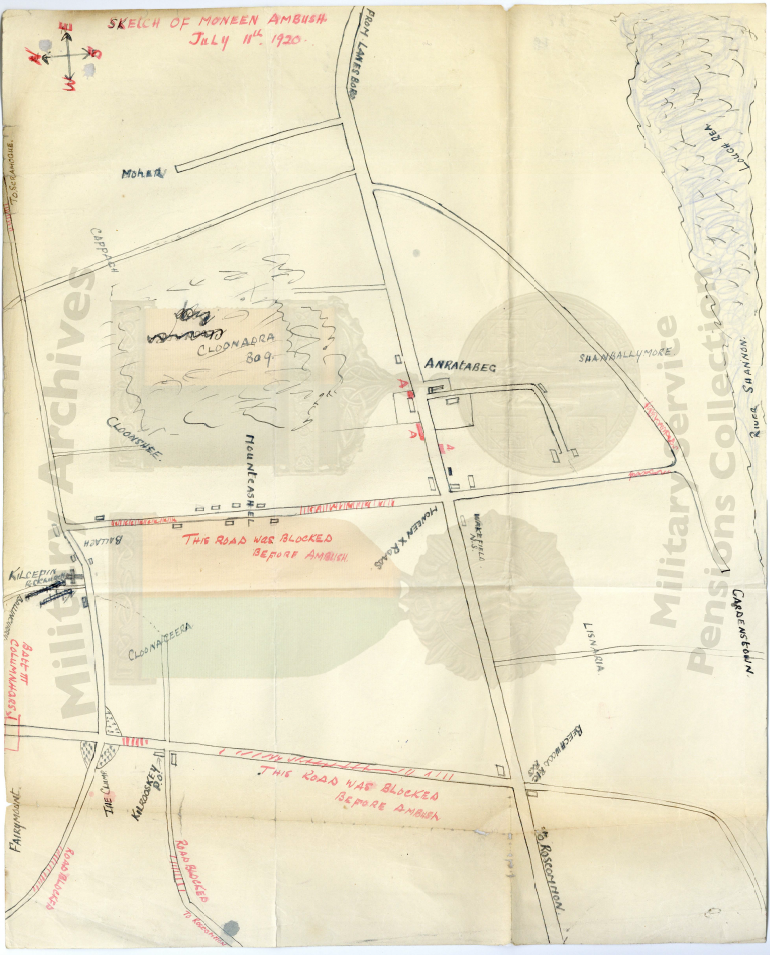
Colonel Frank Simons, Abbey Street, Roscommon, was a 2nd Lieutenant, South Roscommon Brigade, between 1917 and 1921. In 1952 Simons recounted the ambush in writing for the Bureau of Military History. He recalled that they had taken up a position at a place called Anrattabeg and were on the side of the road behind a small wall:
“Pat Madden was in charge with about seven others, including myself. We all had revolvers and two service rifles, and the remainder were also armed with shotguns. We had taken some lengths of rope for tying them up. It was never intended to shoot them. No obstacle was placed on the road, as this would probably have been observed by the police and would have forewarned them.”
“Our scout came along and told us that they, the police, were coming about 150 yards in his rear. When they came to our position, we called on them to halt. They did not halt but, instead, bent low on their cycles and started to pedal faster and passed by. We fired over their heads. We then got out on the road and ran after them, firing over their heads. They began to move with greater speed down the incline on the road from us, and now we fired at them and one man fell off his cycle into the hedge.”
Similar to Luke Duffy, Frank Simons details how they found the policeman in the ditch to be dead. The other policeman surrendered, his rifle was taken from him, and he was placed under guard. This policeman subsequently attempted to disarm his guard and the guard's gun went off. The policeman fell to the ground and all thought that he had been shot. They found out subsequently, when they were gone, that he walked back to Lanesboro.
On the 2nd March 1956, Commandant Gerald Davis of the Defence Forces Army Medical Corps committed to writing for the Bureau of Military History details of Irish Volunteer activities, Roscommon–Athlone, and 'C' Company, 3rd Battalion, Dublin Brigade, during the period 1917–1921. Gerald Davis was present at the Moneen ambush in the summer of 1920, when he was home in Roscommon from college in Dublin. He describes it as the “first real act of hostility”:
“We took up position alongside the main road and when the policemen came along on cycles we called on them to halt. They did not halt but, instead, increased their speed; so we opened fire on them. One policeman immediately fell from his cycle; he had been killed outright. The other man jumped from his cycle and unslung his rifle and made for some cover, but after a few moments he came out and surrendered. We secured two rifles and a small amount of ammunition which we took away with us. We did not take the cycles. Pat Madden, Frank Simmons, Luke Duffy, Henry Compton and I made up the ambushing party. We had a couple of rifles and two or three shotguns and a few revolvers. We allowed the policeman who surrendered to go free when we had secured the arms.”
The foregoing are the only accounts of the ambush at Moneen committed to writing by members of the unit involved in the attack.
Coroner's Court
On the 15th July 1920 a Coroner's Court was held by Dr Vincent Delaney, Coroner for Co. Longford. The inquest was arranged to be held at 4pm; only four of the jury turned up. Evidence was given by Constable Lawrence Joseph Macken, who was with Constable Clarke when they were ambushed, and by Doctor J. A. O'Halloran, Lanesboro, who gave evidence of having examined the body of Constable Clarke, giving details of the injuries and cause of death.
The doctor gave evidence that he found on the left-hand side of the neck, over the external jugular vein, a punctured wound about ⅜" in diameter, apparently caused by a rifle bullet. On the constable's back, on the left-hand side about the level of the 6th or 7th rib, he found an incised wound about 1½" long, which severed the rib completely and penetrated the lung. Doctor O'Halloran stated:
“This wound could be caused by a bayonet or similar instrument and with considerable force. Either of these wounds would be sufficient to cause death in less than five minutes.”
Following the Coroner's Court, Constable Clarke's body was removed to his home town of Ballygar, Co. Galway, where he was buried locally. Constable Clarke's home place in Ballygar is approximately 15 miles from the townland of Moneen where he was killed. It was reported in the Roscommon Messenger of the 17th July 1920 that Constable Clarke was well known in Roscommon before his transfer to Lanesboro.
Notes
Martin Clarke was one of twins born on the 25th May 1889 in Glanworth, Co. Cork. He had one sister and three brothers. His father Martin was an R.I.C. constable who was stationed there; Martin Clarke snr's R.I.C. number was 38538, and records show that he was pensioned on the 11th April 1897. The census of 1901 shows that Martin Clarke snr lived with his mother, his wife Ellen and three sons — James, Martin and Michael — at Killeroran, Ballygar, Co. Galway.
James Clarke, born 13/10/1885, was Martin Clarke's older brother, and he joined the R.I.C. at the age of 20 years on 1/3/1906. He is recorded as being single, a Catholic, 5'9⅛" in height, with a previous occupation as an asylum attendant. On 1/6/1906, on completion of training, Constable James Clarke, 61721, was allocated to Co. Limerick, where he served in Croom until he was promoted to Acting Sergeant on 1/10/1913, when he was transferred to Co. Roscommon. On 1/8/1916 James Clarke was promoted to Sergeant and transferred to Ballinameen. On 19/11/1917 Sergeant Clarke married Margaret McDermott from Riverstown, Co. Sligo; his brother Martin was his best man. On 8/12/1918 Sergeant James Clarke died in Ballaghaderreen, Co. Roscommon, of influenza and pneumonia.
Martin Clarke jnr was appointed to the R.I.C. at the age of 20 years on the 20th September 1909. He was recorded as being single, a Catholic, 5'9¼" in height, with no previous occupation. On the 8th April 1910, following completion of training, Constable Clarke, 64977, was allocated to Roscommon Station. In 1918 he was transferred to Boyle, and in 1919 to Lanesboro J.S. Constable Clarke is recorded as having died on the 14th July 1920, having been “murdered by armed assassins”; he was single, 31 years old, with 11 years' service.
Constable John Kearney, 60126, was stationed in Lanesboro in 1920. A native of Westmeath, he joined the R.I.C. at the age of 22 on the 15th April 1901 and was allocated to Donegal on the 26th October 1901. On the 6th November 1908 he was transferred to Longford. On the 5th February 1910 Constable Kearney married. He resigned on the 23rd August 1920, having 19 years' service. The reason recorded for his resignation was “to manage a farm for his uncle”.
Constable Lawrence Joseph Macken, 67165, a native of King's County (Offaly), joined the R.I.C. at the age of 19 on the 18th March 1913, and following training at the R.I.C. Depot, Phoenix Park, was allocated to Roscommon on the 7th October 1913; he had no previous employment. On 1/12/1920 Constable Macken transferred to Dublin. On the 22nd August 1922, at the age of 27 years, having completed 9 years' service, he retired from the R.I.C. on disbandment, with an annual pension of £91 7s. 9d. There is no record of Constable Macken having married during his service.